Seventh episode. The voice of science. We descend to the seafloor.
In the Heroes of the Undercurrent series, we speak with the people driving the sustainability transition from within. In the previous two episodes we listened to the atmosphere and the ocean. Wim Thiery told us that CO₂ is the forever chemical of the climate, that every gram we emit adds a new lock-in. René van Westen showed us that the AMOC, the engine that keeps Europe eight to ten degrees warmer than it would otherwise be, is measurably on course towards a tipping point. Both closed with the same uncomfortable truth: the physics does not negotiate.
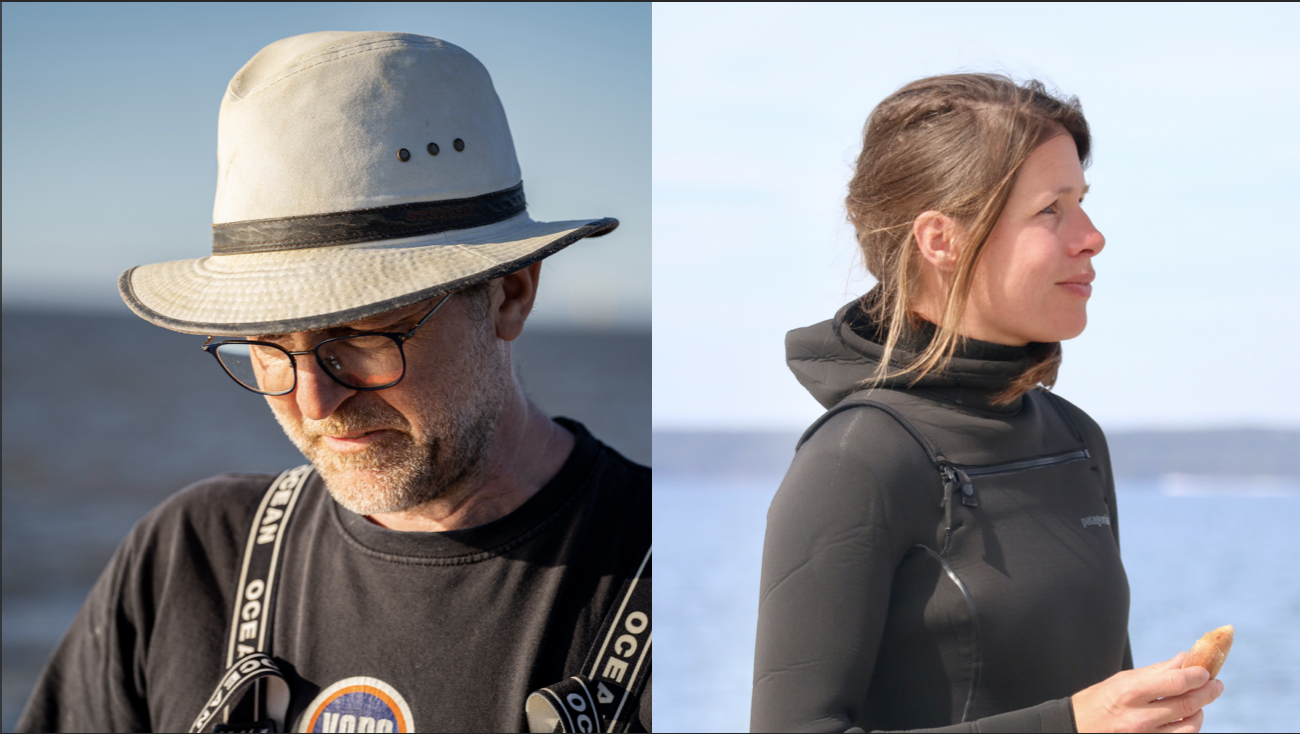
Now we descend a layer further. To the seafloor. To the mudflats, the seagrass beds, the fish that feed a continent and the reefs that have been scraped clean over centuries. We spoke with Britas Klemens Eriksson, professor of marine ecology at the University of Groningen, and Laura Govers, associate professor of marine conservation ecology at the same institution. He diagnoses what is being lost at the system level. She builds what might come back. Together they form two sides of the same story.
It was a conversation that stayed with me. Not because of what was extreme. Because of what was ordinary.
Wim Thiery described the warming of the atmosphere. René van Westen described the slowing of the ocean's great conveyor belt. Eriksson and Govers work in what lies at the intersection of both: the Wadden Sea. A shallow coastal ecosystem stretching across the northern coasts of the Netherlands, Germany and Denmark. A UNESCO World Heritage site. One of the most productive marine ecosystems on the planet.
And a system that is, by any honest measure, a fraction of what it once was.
Things are starting to move. Things are starting to change into something different that we really can't predict very well. And that is, for us, a bit concerning.
— Klemens Eriksson
Eriksson is careful with language. He does not reach for apocalyptic framing. He is a scientist who works with data, with population models, with long-term monitoring series. What he describes is not catastrophe in the dramatic sense. It is something more unsettling: change that is large, real, well-evidenced, and largely invisible to anyone not looking for it.
Laura Govers works on restoration. She replants seagrass in the Wadden Sea, advises the Dutch Ministry of Agriculture on nature restoration, and sits on the board of the European Seagrass Restoration Alliance. Her work is hands-on in a way that few ecological scientists allow themselves. She is, by her own description, someone who believes in doing rather than waiting.
Between them, the conversation covered almost a full hour. What follows is what mattered most.
The word 'unprecedented' appears in almost every conversation about the state of our natural systems. It has, through repetition, lost some of its weight. Govers restores it.
The rate of change has never happened through history. Even if we look in a deep time context, ecosystems are always slightly dynamic, but the rate of change now is unprecedented. We really don't know what the future will look like.
— Laura Govers
This is not a rhetorical claim. It is the concept she and her colleagues call ecological novelty: the emergence of conditions for which no historical analogue exists, in which species must navigate an environment that evolution has not prepared them for. The Wadden Sea is entering that territory.
What makes this difficult to communicate is that it does not look like a catastrophe from the outside. The tides still move in and out. The birds still feed on the mudflats. The boats still go out. The water is turbid, as it has always been. Govers points to that turbidity as part of the problem: beneath the surface of a brown sea, almost nothing is visible to the casual observer. And almost everything that is changing is happening down there.
The Wadden Sea is one of the most productive seas globally, especially because of its intertidal character. It always had a huge biomass of species, both swimming and living in the sediment. That is another layer of invisibility: under the water, and then under the seabed as well.
— Laura Govers
Invisible change is, in some ways, more dangerous than visible change. Van Westen's AMOC paper woke the world precisely because it made something measurable. What Eriksson and Govers study is harder to point at. But no less real.
Here is the number that stopped me in the conversation.
A study twenty years ago already showed that the state of the Wadden Sea is only around 30% of what it used to be historically, in terms of species diversity, abundance, and biomass. So that drama has already happened.
— Laura Govers
Thirty percent. The Wadden Sea that the current generation of biologists, fishermen, tourists and policymakers experience as a rich, wild, living place is already a shadow of what existed a century ago. The oyster reefs that once covered enormous sections of the North Sea floor, scraped up and sold as cheap food in harbour towns. The seagrass meadows that spanned 150 square kilometres, providing nursery habitat for herring, eel, and bottlenose dolphins, gone since the 1930s following a combination of the closure of the Zuiderzee and a wasting disease that wiped them out across the northern hemisphere, but from which they recovered everywhere except here, because the system had already shifted too far to allow them back.
This is the concept Govers calls ecological amnesia. Each generation inherits the diminished version and experiences it as normal. The scientists who called the return of mussel beds one year ago the best they had ever seen were astonished. The old people on the islands were less impressed.
The old people on the islands said: 'Oh, this is nothing. This is almost back to when there were only a few mussels when I was a child.' Their ecological memory was much, much longer. What we celebrated as a fantastic new mussel system was, to them, barely a recovery.
— Klemens Eriksson
Shifting baselines. Each generation takes its own youth as the reference point. As the years pass and the older witnesses disappear, the reference point sinks. What is lost becomes not just invisible, but literally unremembered.
This is why storytelling matters more than most scientists are trained to believe. The old fisherman's grandfather fished a completely different community of species. Today's fishermen manage shrimp and mussel cultivation in a system that is, by any historical measure, ecologically impoverished. But because the change happened gradually, across generations, no one person ever experienced the full arc of loss.
What is driving the changes in the Wadden Sea? The honest answer, and the one that makes communication so difficult, is: many things at once.
Climate change is real and measurable in the data. Eriksson and his research group can see the fish species shifting northward, following the temperature gradient. Southern species are appearing in the western Wadden Sea. Northern species are retreating. But the new arrivals are not compensating for what is leaving, neither in biomass nor in ecological function.
Climate change is really changing which species are doing well, which species are the winners. And it is making a lot of species losers. But it is not only climate change.
— Klemens Eriksson
The direct attribution of damage to human action matters here, and Eriksson and Govers are unambiguous about it. Bottom trawling has been one of the most destructive single practices in the Wadden Sea: scraping the seafloor repeatedly, destroying the structural complexity on which fish larvae and benthic communities depend. The conversion of coastal salt marshes to farmland removed the productive nursery zones where juvenile fish would have grown. The closure of the Zuiderzee disconnected the Wadden Sea from what had been its most important interior habitat.
This is the attribution problem that Wim Thiery described at the atmospheric level: the new science of impact attribution, of source attribution, of linking specific damage to specific decisions and actors. At the ecosystem level, Eriksson and Govers make the same connection without the mathematical precision of climate attribution science, but with no less clarity. The current state of the Wadden Sea is the result of identifiable human choices, made over decades, that are now written into the system.
It is a combination of all these factors adding up on each other. That makes it so complex, because we can never point to one thing as the problem. And that also makes it very difficult among scientists, because someone says: it's climate change. Someone else says: it's fisheries. While the truth is we need to look at it holistically.
This complexity is not an invitation to inaction. It is an argument for holistic management: addressing all the drivers simultaneously, rather than waiting for consensus on which single cause is dominant.
— Klemens Eriksson
The word I used in our pre-conversation, collapse, was gently but firmly corrected by both scientists. What has happened in the Wadden Sea, and what is continuing to happen, is not collapse in the sense of sudden total failure. It is, in their framing, something different: state changes, regime shifts, large and in some cases irreversible transitions from one ecological configuration to another.
Those state changes have already happened. The European oyster reefs are gone. The seagrass beds are gone. The system that remains is productive, but it is a profoundly altered version of what existed before. Calling it a collapse would be inaccurate. Calling it fine would be catastrophic.
We have had collapses. The haddock, salmon and sturgeon fisheries have collapsed. The flat European oyster reefs across the North Sea floor: we scraped the whole bottom and threw them on land and sold them as poor man's food in the harbours. That you can call a collapse. But for the sea as such, I don't see major thresholds coming up that would suddenly change everything. We see gradual changes. And those gradual changes can be very, very large.
— Klemens Eriksson
This distinction matters strategically. The risk of threshold framing, of saying 'collapse is coming', is that it gives false comfort to those on the wrong side of the threshold: if the system has not yet collapsed, there is no urgency. Eriksson is wary of this.
We sometimes talk about waiting for a shift. I don't think we have time to wait for a shift. We need to address the issues we see today. The drama is not coming. It is already here.
— Klemens Eriksson
Govers offers the most vivid illustration of what that future looks like if current trajectories continue. In the Delta works region south of the Wadden Sea (an area closed off from tidal connectivity decades ago), she and her team work on seagrass restoration while snorkelling through water that is now, paradoxically, clear. Clear because almost nothing is left.
There is barely any fish because it has been fished out and there is no way for fish larvae to come back in. It is one big lake of jellyfish. When we work there in summer, snorkelling for our seagrass restoration project, there are jellyfish in your face non-stop. Crabs eat everything you try to plant. That is what the future will look like. And I think the issue is that people still see that as nature.
— Laura Govers
A sea of jellyfish, clear water, beautiful to swim in. Ecologically empty. And experienced by the people who visit it as a natural environment. That is the endpoint of ecological amnesia: the impoverished future normalised before it has even fully arrived.
There is a version of scientific caution that has become, in the Netherlands at least, a form of institutional paralysis. Eriksson names it directly.
We have been measuring things in nature for fifty years. It is not going to make a big difference if we measure for five more years. We have enough knowledge to make our best guess based on the scientific evidence. In many things, we have enough evidence to at least come with sound recommendations.
— Klemens Eriksson
Modern conservation and restoration science, the kind Govers practises, operates on a different principle: act on the best available evidence, measure the results, adapt as you go. The artificial reef project Eriksson's group created, the largest in the Netherlands, started with a few reef structures and a monitoring programme. When they saw results after three years, they scaled up. This is the methodology of informed, evaluated action, not the methodology of waiting for a perfect model before doing anything.
Against this, Govers raises something uncomfortable about how expertise is actually used in policy processes. When environmental decisions are made through obligatory tender processes, the standard procurement model in the Netherlands and across Europe, the expertise that ends up advising government is not always the deepest expertise available. It is the expertise that responded to the tender.
We have a lot of unique expertise in the Netherlands that is now insufficiently consulted in the Netherlands when it comes to policy making.
— Laura Govers
This is the commodity expert problem: the procurement process systematically selects for availability and price over depth of knowledge. For an ecosystem already as deeply impoverished as the Wadden Sea, this is not an administrative detail. It is a structural risk to the quality of every restoration plan being developed under the EU Nature Restoration Law.
One of the most significant things that emerged from this conversation was something I had not expected: genuine, evidence-based optimism about the legal architecture taking shape at the European level.
The EU Nature Restoration Regulation, now in the process of being translated into national implementation plans across all member states, places obligations on governments that are qualitatively different from anything that came before. Ninety to one hundred percent of degraded natural ecosystems restored by 2050. Measurable milestones at 2030 and 2040. And, crucially, legally binding in a way that earlier environmental directives were not.
This is way more of a legal obligation than some previous conservation laws. I'm very hopeful that this will give us the legal support. And we are on the table: we are involved in the development of these plans.
— Laura Govers
This is the pathway from science to binding policy that van Westen and Thiery described at the climate level: the scientific community converging, that convergence entering international law, that law creating enforceable obligations that national governments cannot simply defer indefinitely. The Water Framework Directive showed how this can stall. The Netherlands is performing poorly on its obligations, as are most European member states, through a pattern of perpetual postponement. But the Nature Restoration Regulation has correction mechanisms built in. The EU is getting better at closing the legal exits.
Govers is advising the Dutch Ministry directly on marine restoration and is actively involved in translating European seagrass restoration science into policy recommendations at the EU level. Eriksson has advised on shrimp fisheries management. The pipeline from scientific evidence to legally enforced action is not theoretical. It is moving.
What this means for companies operating in the F&B sector is a regulatory landscape that will tighten, not loosen, around coastal ecosystem use, regardless of what happens to individual national political cycles. The external regulator may be stepping back at the national level, as Thiery observed. The European legal architecture is stepping forward.
For our sector, the Wadden Sea is not an abstraction. It is a supply chain.
Shrimp, mussels, cockles, flatfish, eel: these are products that enter the food system from the Wadden Sea and its surrounding waters. The productivity of these fisheries depends directly on the ecological functions that Eriksson and Govers study: the nursery habitats that salt marshes once provided, the structural complexity that intact reef systems created, the water-filtering function of bivalves, the food web connections that have been disrupted at every level from seagrass to apex predator.
The direct attribution point matters here. This is not only climate change. It is also the direct result of identifiable practices: bottom trawling, habitat conversion, the loss of connectivity. Some of those practices are within the scope of decisions that buyers, certification bodies and procurement managers make today.
Van Westen warned about the compounding of systemic risks across supply chains. Thiery described the lock-in of emissions and their irreversibility. Eriksson and Govers add the local layer: the nursery habitats are largely gone, the species that are disappearing are the productive ones, and what arrives to replace them does not compensate in biomass or ecological function. A supply chain that depends on this system is exposed not to a future risk but to a present one that has been building for decades.
For a CEO, this must be easy to understand: you diversify your portfolio. As a society, we need to do that with nature. We need to be much more resilient. And we need to start doing it now, rather than waiting for a dramatic threshold that tells us it is finally urgent enough.
— Klemens Eriksson
Food is culture, as both scientists acknowledge. Changing consumption patterns is slow, contested, and culturally sensitive. But the direction of change, as Govers observes after twenty-seven years as a vegetarian, is already happening. Attitudes that once required defending are now assumed. The diversification of diets, reducing but not eliminating, shifting but not abandoning, is a frame that allows movement without demanding conversion. And the leverage that large-scale F&B operators have in accelerating that diversification, through menu design, procurement choices, sourcing decisions and what is made the default rather than the exception, is substantial.
Eriksson does not use the language of doom. Neither does Govers. What they offer instead is something more demanding: the acknowledgement that the drama is already here, combined with the insistence that what we do next determines how much further it goes.
What we are experiencing now is a bump in the road. It feels very significant, and it is important to communicate about it. But we were actually on a good track. In Europe, we have decreased our carbon footprint. China is for instance undergoing an amazing transformation. We just need to push on and make sure the backlash doesn't take over. I really believe it's just a bump in the road.
— Klemens Eriksson
The inconvenient truth is back. That phrase, used in our opening conversation and immediately recognised by both scientists, describes something real about where the public conversation stands in 2026. The momentum of 2022 and 2023 has thinned. Political ambitions are being scaled back. The urgency has been partially replaced by the language of manageable transition.
But the undercurrent, as this series has always insisted, does not follow the news cycle. The EU Nature Restoration Law is being written. The attribution science is getting sharper. Restoration ecology is scaling. And in the Wadden Sea itself, there are signs that are, for people with long enough ecological memories, not just promising but genuinely exciting.
In my courses I tell students how bad things are in the first week, and they get depressed. But then I tell them: we need to know this to be able to act. Because we also have so much power to change it for the better. If we act now, we might see abundant sharks, rays and bottlenose dolphins back in the Wadden Sea as functional apex predators. That is futures thinking: showing people the desirable outcome, not just the disaster we want to avoid. People can relate to a dream more than to doom.
— Laura Govers
Abundant sharks, rays and bottlenose dolphins in the Wadden Sea as functional apex predators. Not a fantasy — all three are occasional visitors to these waters today. What Govers envisions is their return as a permanent, ecologically shaping presence: predators that structure the system from the top down, the way they once did. Govers knows this is achievable because she and her colleagues are already building the constituent parts: seagrass, that doubled in extent on Griend in a single year. Reefs, that begin to attract fish communities within a few seasons. Connectivity, that can be partially restored through policy changes that are being written now.
The question van Westen put to us at the end of his episode, what did you know, and what did you do about it, is the same question that Eriksson and Govers' work poses, just one ecosystem layer closer to home.
We know what the Wadden Sea was. We know what it is. We know, with reasonable confidence, what it will become if we carry on. And we know what it could become if we do not. That is not a small amount of knowledge. It is enough to act on.
The sea forgets nothing. The question is whether we will.
This interview is part of the Heroes of the Undercurrent series by Conceptional. Previous episodes: Debbie Rooms (Compass Group Netherlands), Inge van Baardwijk (Royal Schiphol Group), Manon van Leeuwen, Inan Şahin (Efteling), Wim Thiery (VUB) and René van Westen (IMAU, Utrecht University). Britas Klemens Eriksson is professor of marine ecology at the Centre for Ecological and Evolutionary Studies, University of Groningen. Laura Govers is associate professor of marine conservation ecology at the University of Groningen / NIOZ. The article was submitted to both for approval prior to publication.