In the grand tapestry of European policy, a once-bold thread of ecological ambition is coming undone. Where there was once a collective drive toward sustainability, a confluence of political populism, economic pragmatism, and transatlantic policy shifts is leading to a marked departure from decisive climate action. This shift, while politically convenient, is dangerous—especially for the Food & Beverage (F&B) industry, which sits at the nexus of food security, environmental responsibility, and shifting consumer expectations.
Yet, if there is one thing history teaches us, it is that true progress is not dictated by external pressures alone. It is steered by leadership—by those willing to make sustainability not a buzzword, but an operational reality.
Across Europe, right-wing populist movements are gaining ground, many of them questioning, downplaying, or outright opposing ambitious environmental policies. Their primary argument? Green regulations stifle economic growth, burden businesses with excessive red tape, and are driven more by ideology than practicality.
The political consequences of this shift are evident. Policies once considered non-negotiable—such as the European Green Deal's Farm to Fork Strategy—are being diluted or delayed. The recent softening of environmental policies related to agriculture, biodiversity, and energy underscores the growing influence of these forces. When the European Parliament voted to roll back environmental restrictions for farmers, it was not out of ignorance but political necessity, as pressure from conservative rural voters and economic hardships mounted.
Additionally, there is a growing call to reduce regulatory burdens associated with sustainability initiatives, most notably the Corporate Sustainability Reporting Directive (CSRD). While intended to enhance transparency and accountability, CSRD is increasingly framed by critics as an administrative burden that stifles business agility. This rhetoric aligns with populist narratives that position environmental regulations as obstacles to economic growth, further weakening the policy framework designed to drive corporate sustainability efforts.
Europe's political realignment on sustainability is not happening in a vacuum. Across the Atlantic, a second Trump presidency has signalled a wholesale retreat from climate leadership. The dismantling of Biden-era emissions targets, the push to expand fossil fuel extraction, and the withdrawal from global climate commitments have created a permissive environment for climate scepticism. For European leaders who once looked to the U.S. as a partner in global climate action, this shift is a clear indication that the political winds have changed. It has also emboldened industries and policymakers who see sustainability as a financial burden rather than a competitive advantage.
While politics may drive policy, businesses ultimately bear the operational consequences. The F&B sector, already squeezed by declining consumer spending, inflationary pressures, and supply chain disruptions, now faces a dangerous paradox: the weakening of sustainability mandates could provide short-term cost relief but at the risk of long-term resilience. Many businesses might be tempted to deprioritise or slow down sustainability in response to financial pressures.
This, however, is a critical mistake. If anything, sustainability should be at the core of strategic decision-making—integrated not as a side project, but as the foundation of business operations. As sustainability is a transition, not a trend, we need to factor in multiple years of hard work before this transition can be successfully embedded while balancing consumer needs, organisational capability, and financial health.
The weakening of ecological ambition at the political level—driven by populist pressure, shifting U.S. policies, and economic pragmatism—creates a dangerous precedent. Where governments once pushed industries toward sustainability, they are now either retreating or deprioritising green commitments. This shift removes external pressure and accountability, allowing businesses to slow down or abandon sustainability efforts under the guise of short-term financial concerns.
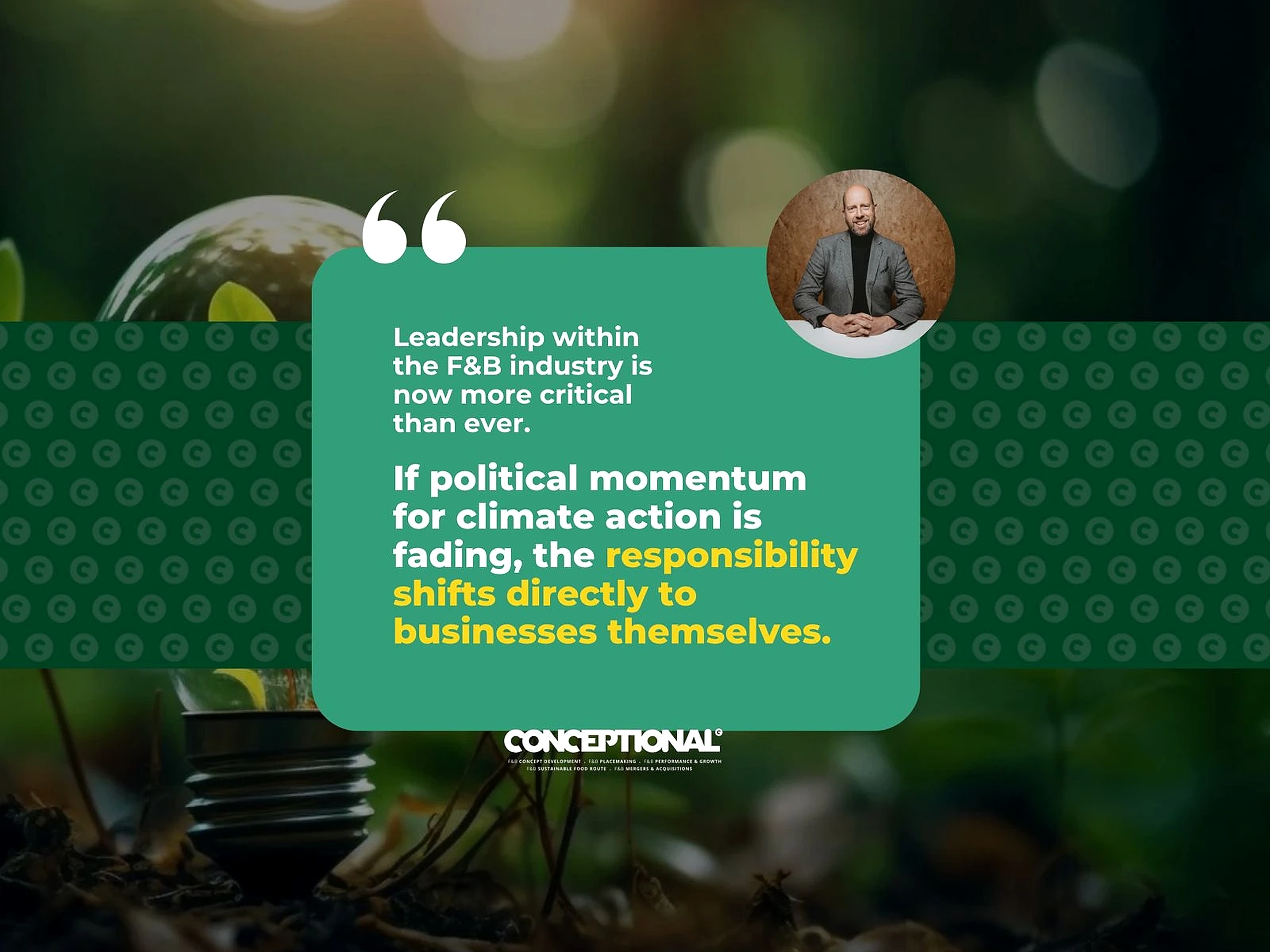
Yet, this is precisely why leadership within the F&B industry is now more critical than ever. If political momentum for climate action is fading, the responsibility shifts directly to businesses themselves. Without strong leadership, the industry risks not only environmental backsliding but also economic stagnation, as shifting consumer expectations, regulatory uncertainty, and long-term resource scarcity continue to challenge business resilience. Now is the time for F&B organisations to step up, take ownership, and integrate sustainability as a fundamental business strategy—because waiting for external forces to dictate change is no longer an option.
The real crisis is not just political—it is a leadership crisis at all levels. Across the F&B industry, sustainability efforts stall for three primary reasons:
True leadership on sustainability is not about making statements; it is about driving change at every level of the organisation. This requires:
At Conceptional, we recognise that sustainability fails without structure. That's why we have developed The Sustainable Food Route, a methodology designed to ensure sustainability is fully integrated and becomes business as usual. Over the last few years, we have been able to support many of our clients ranging from international airports and amusement parks to highly competitive catering companies.
By embedding sustainability across resources, systems, processes, policies, and planning, this approach moves organisations beyond lip service, beyond vague ambitions, and operational bottlenecks—ensuring that sustainability is not just a leadership vision, but an organisational reality.
The question now is: who is ready to lead, and who will get left behind?